Audio to MIDI converter:
check the notes you keep
Audio to MIDI turns a recording into editable note events; this converter follows one pitch at a time, so use an isolated part and check its saved draft, while simultaneous parts need a polyphonic transcription path. Evidence
Open the browser converter · Compare the five tests · Download the recordings and MIDI
1. What this comparison measures
All five actual browser downloads matched the unchanged production algorithm’s offline MIDI byte for byte, allowing the saved event comparisons below without claiming a general converter accuracy rate. Evidence
The batch reuses one human GuitarSet recording, applies declared processing controls and adds a real Vienna piano performance for a controlled two-instrument mix, without replacing either instrument with synthesized notes. Evidence
The frozen main match requires the same integer MIDI pitch and an attack within fifty milliseconds, choosing the nearest unused output in reference order without fitting a shift or crediting an octave substitute. Evidence
Reference attacks come from per-string guitar annotations and calibrated piano hardware key events, so overlapping strings, pedal decay, separate recording rooms and calibration uncertainty limit what this panel can establish. Evidence
The saved MIDI uses format zero with one track at 480 ticks per quarter note and separate Note On and Note Off events, while the accompanying time tables use seconds and integer MIDI pitch numbers. Evidence
2. Five conditions, with the failures visible
| Condition | Reference attacks | Output events | Strict matches | Missed | Extra | Reference / output maximum simultaneous notes |
|---|---|---|---|---|---|---|
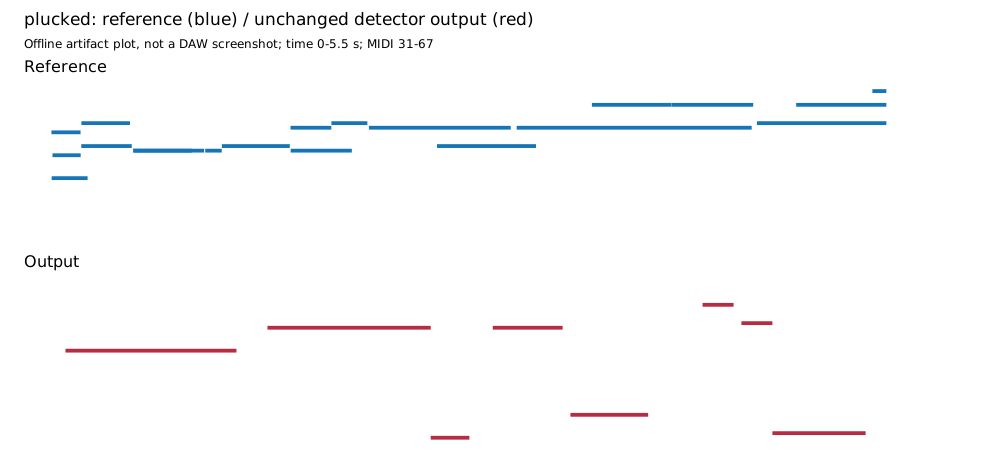
| Real plucked recording | 20 | 8 | 0 | 20 | 8 | 3 / 1 |
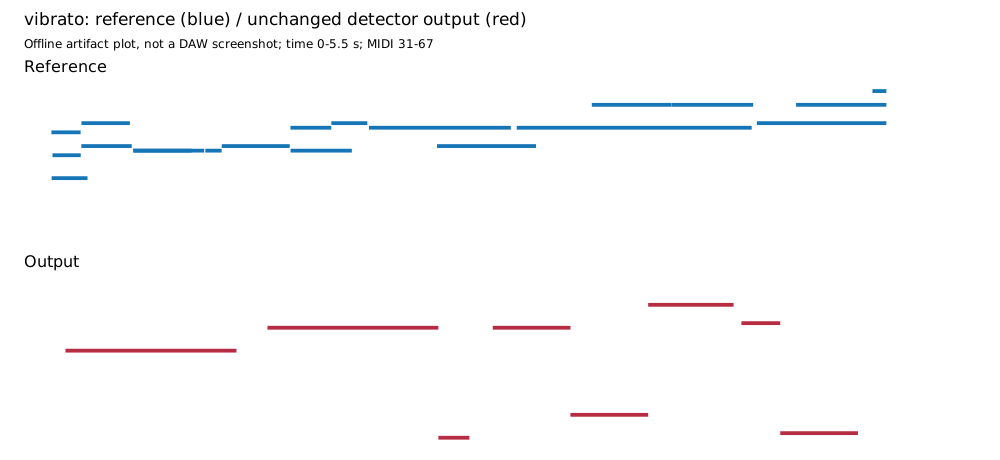
| Controlled vibrato on real recording | 20 | 8 | 0 | 20 | 8 | 3 / 1 |
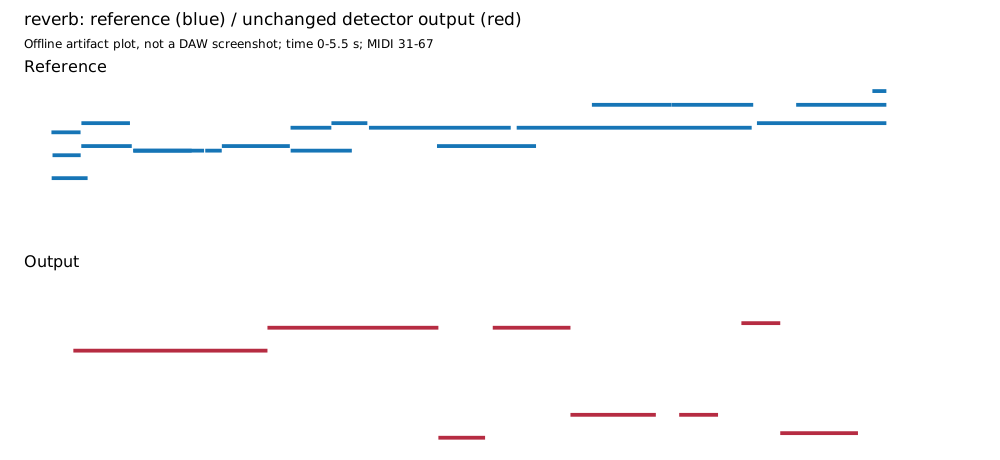
| Declared delay/reverb control | 20 | 8 | 0 | 20 | 8 | 3 / 1 |
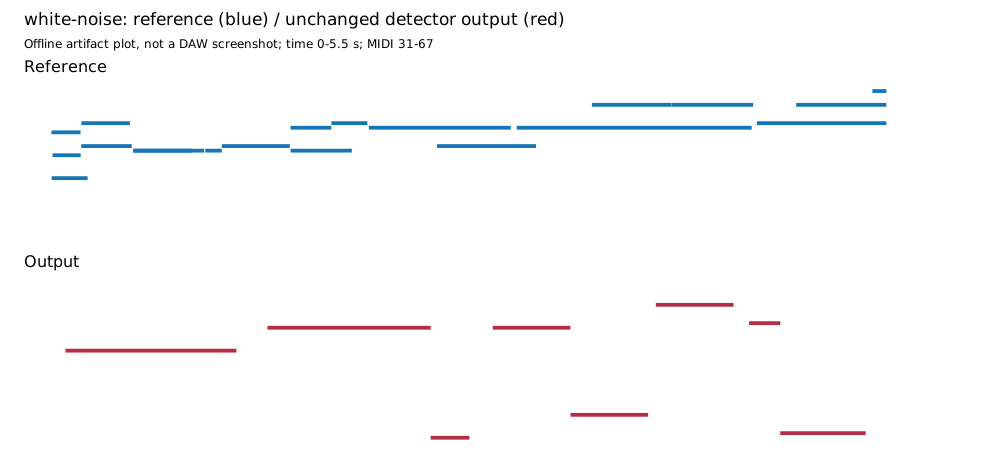
| Added white noise | 20 | 8 | 1 | 19 | 7 | 3 / 1 |
| Controlled real guitar + piano mix | 45 | 10 | 0 | 45 | 10 | 6 / 1 |
In this fixed batch every output stayed at one simultaneous note, including the mix whose reference reached six, so retaining one melodic line must not be presented as recovering its simultaneous parts. Evidence
Plucked notes: pitch identity and attacks are separate checks
The plucked recording produced eight events against twenty annotated attacks and zero strict matches, leaving twenty missed references and eight unmatched outputs under the frozen rule. Evidence
Five of those eight events nevertheless overlapped a same-pitch reference interval, so the zero strict score cannot be read as every stored pitch being wrong. Evidence
Three remaining plucked outputs overlapped only octave-related reference pitches, which identifies concrete candidates for manual register checking without awarding them exact-pitch credit. Evidence
A posthoc wider attack window yielded three plucked matches instead of zero, demonstrating that the declared timing tolerance changes this count without repairing the MIDI itself. Evidence
Vibrato: a stable pitch list does not prove expressive recovery
The controlled-vibrato output retained the baseline sequence 52, 57, 33, 57, 38, 62, 58 and 34, but its complete event data changed, so matching pitch lists alone would hide a changed draft. Evidence
In the vibrato draft the third output, pitch 33, began about 46 milliseconds later while the sixth, pitch 62, began 325 milliseconds earlier than their baseline counterparts, so one global time offset cannot align both exported drafts. Evidence
The vibrato MIDI contains zero Pitch Bend channel messages, which rules out treating this particular saved file as evidence that continuous expressive bends were recovered. Evidence
Vibrato and plucked both scored zero with the primary timing rule, yet the wider exploratory window accepted four and three respectively, exposing timing sensitivity that identical event totals conceal. Evidence
Reverberation: equal totals can hide a register change
Reverberation kept the total at eight events while same-pitch interval overlaps fell from five to four and octave-only overlaps rose from three to four, so the equal event total concealed a different pitch allocation. Evidence
The sixth sorted output changed from pitch 62 to 38 and began about 140 milliseconds earlier in the exported MIDI, an ordinal two-octave difference that does not by itself prove both events identify the same performed note. Evidence
White noise: a boundary crossing is not an accuracy promise
Added noise preserved the baseline pitch sequence but moved one pitch-58 attack inside the frozen timing boundary, changing strict matches from zero to one without establishing that noise improves transcription. Evidence
That accepted noisy attack arrived about 47 milliseconds early and its stored duration was about 587 milliseconds shorter than the reference, showing that an accepted onset still needs an ending check. Evidence
Controlled mix: more source notes did not become more simultaneous parts
Adding the real piano increased reference attacks from twenty to forty-five but output events only from eight to ten, so this mix did not turn the single-line draft into a transcription of the added part. Evidence
Six mix outputs shared intervals with exact-pitch references while four had only octave-related overlaps, so zero strict matches must again be separated from complete loss of pitch relationships. Evidence
The mix recovered three strict-pitch attacks only after the exploratory timing window was widened, while maximum output polyphony remained one, separating an onset criterion from the simultaneous-note limit. Evidence
3. Read the diagnostics without moving the goalposts
Interval-overlap counts and the wider 150-millisecond window were added after viewing the main outputs, count outputs differently and must not be substituted for the frozen fifty-millisecond headline matches. Evidence
The five-condition comparison therefore supports inspecting register, attacks, endings and simultaneous notes separately, rather than labeling a draft correct solely because an event count or pitch list looks stable. Evidence
4. Listen, inspect the Piano Rolls and reproduce
Real plucked recording
Listen / download WAV · Actual browser MIDI · Byte-identical offline MIDI · Reference notes · Output notes · Counts and matches
Controlled vibrato on real recording
Listen / download WAV · Actual browser MIDI · Byte-identical offline MIDI · Reference notes · Output notes · Counts and matches
Declared delay/reverb control
Listen / download WAV · Actual browser MIDI · Byte-identical offline MIDI · Reference notes · Output notes · Counts and matches
Added white noise
Listen / download WAV · Actual browser MIDI · Byte-identical offline MIDI · Reference notes · Output notes · Counts and matches
Controlled real guitar + piano mix
Listen / download WAV · Actual browser MIDI · Byte-identical offline MIDI · Reference notes · Output notes · Counts and matches
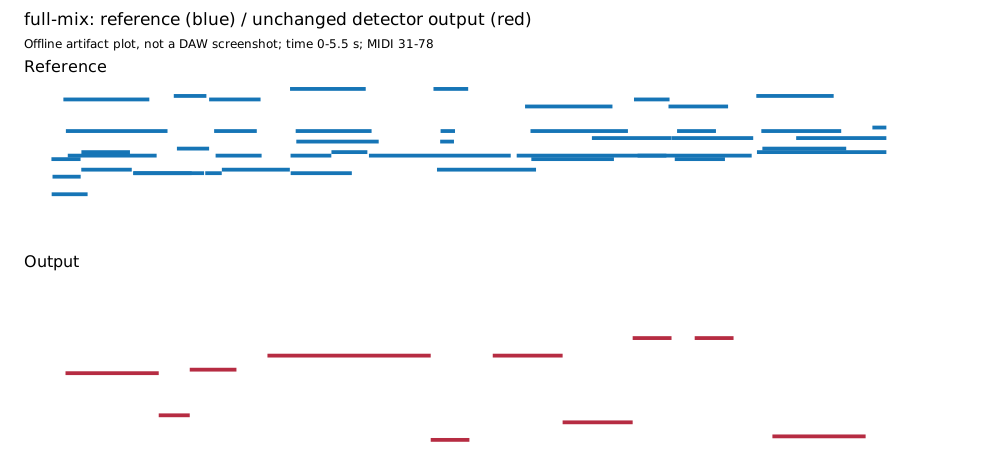
The SVG Piano Rolls are generated reference-versus-output plots rather than DAW screenshots, and the time tables describe MIDI events verified against the actual browser downloads. Evidence
An independent fresh run regenerated fifty common audio, MIDI, reference, table, plot and numeric-result files with identical SHA256 hashes, proving reproducibility of this offline pipeline rather than browser compatibility. Evidence
Frozen protocol · Source transforms · Primary results · Posthoc diagnostics · Unchanged detector · Offline conversion runner · Independent MIDI parser · Source licenses and attribution · Fresh-run SHA256 checks
Reproduction instructions · Portable count and plot scorer · Posthoc diagnostic script · Original Windows input generator · Independent prose arithmetic · Staged evidence SHA256
Five actual browser downloads · Named vibrato timing comparison
Internal evidence sentence ledger · Internal full-body audit · Dated source review and limits · Recording provenance checks
5. Supported formats and browser verification
The ten fixtures were actually tried in this Windows Chrome session: MP3, WAV, FLAC, OGG, M4A, AAC, MP4, MOV, WebM reached a downloaded MIDI, while AIFF failed; these results do not guarantee every codec profile or browser. Evidence
| Tested fixture | Actual browser result | Saved events / evidence |
|---|---|---|
| MP3 | Decoded, converted and downloaded | 7 MIDI events |
| WAV | Decoded, converted and downloaded | 8 MIDI events |
| FLAC | Decoded, converted and downloaded | 8 MIDI events |
| OGG | Decoded, converted and downloaded | 8 MIDI events |
| AIFF | Decode failed in this browser | Actual error and input SHA256 |
| M4A | Decoded, converted and downloaded | 8 MIDI events |
| AAC | Decoded, converted and downloaded | 9 MIDI events |
| MP4 | Decoded, converted and downloaded | 8 MIDI events |
| MOV | Decoded, converted and downloaded | 8 MIDI events |
| WebM | Decoded, converted and downloaded | 9 MIDI events |
Why did the AIFF file fail?
This AIFF sample stopped before note detection with “Unable to decode audio data” in the tested browser; export an ordinary PCM WAV in your audio editor as the next input to try, rather than treating AIFF as supported here. Evidence
6. What the controls do and do not represent
Vibrato is a declared five-hertz periodic time warp of the real recording, reverb is an explicit three-tap delay treatment, noise uses a fixed seed and the mix sums two real performances instead of representing a commercial full-band recording. Evidence
Every audio fixture includes the same half-second tail and contains no clipped PCM samples, while the guitar reference itself contains overlapping string annotations and must not be relabeled a strictly monophonic ground truth. Evidence
GuitarSet and the Vienna piano materials are credited under CC BY 4.0, with our crops, effects, alignment, note analysis and plots disclosed as modifications without source-author endorsement. Evidence
7. Local processing and the next check
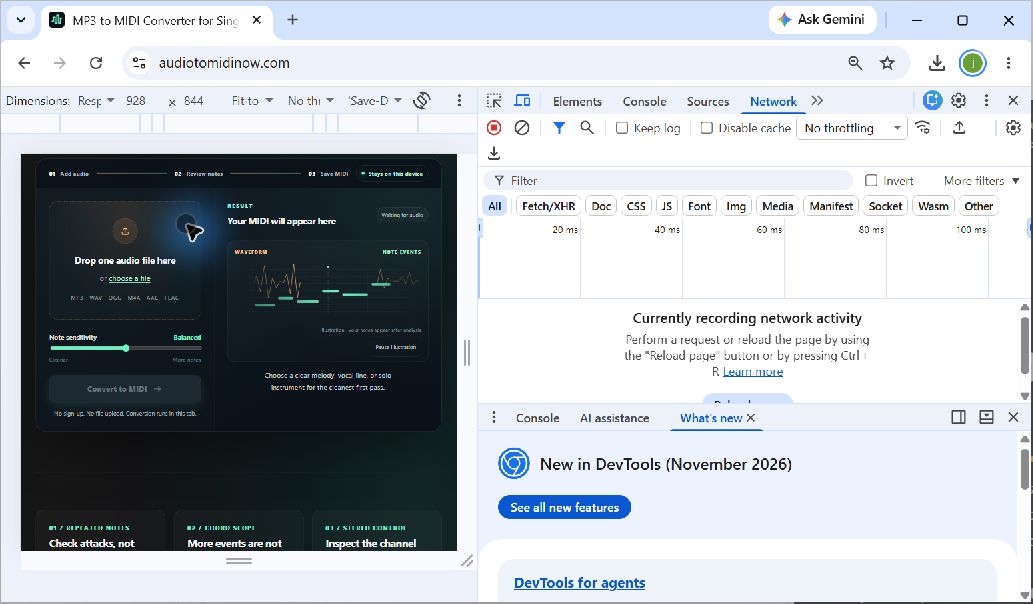
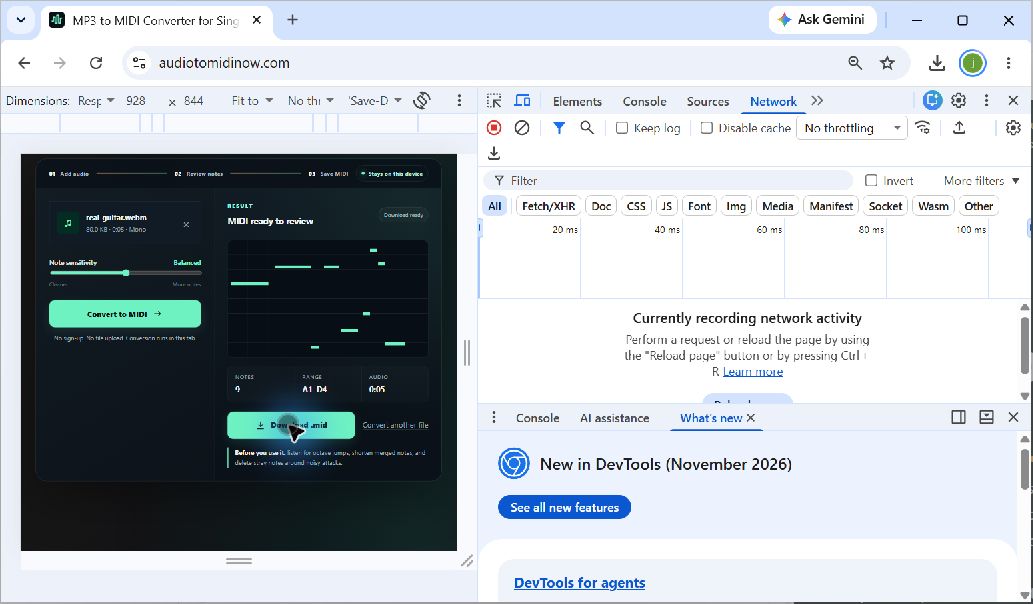
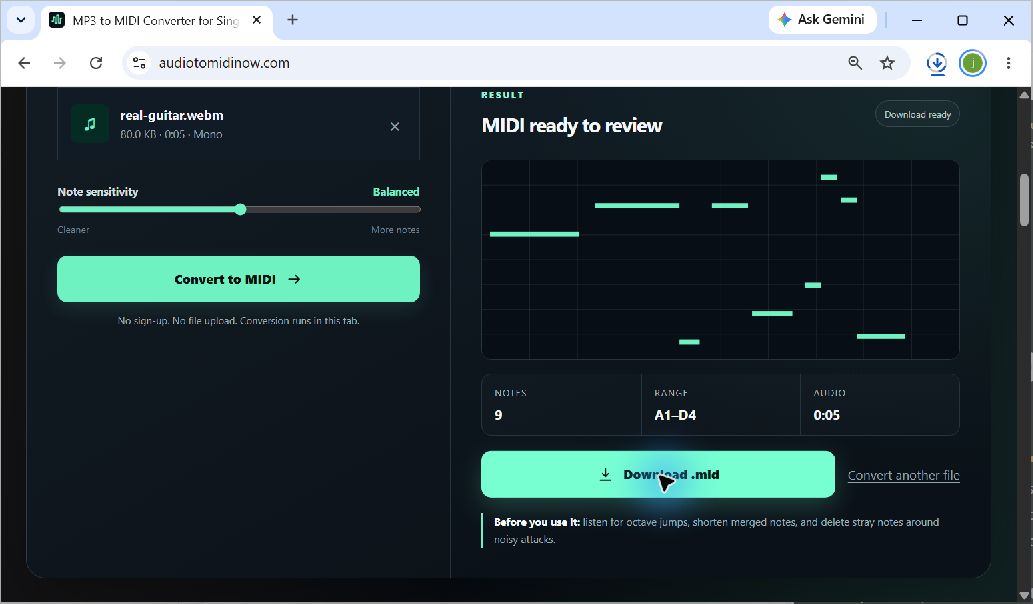
For the observed WebM selection and MIDI generation, Chrome’s unfiltered Network list remained empty and the converter read the local file into a local MIDI blob; this is a scoped conversion check rather than a claim that initial site assets or analytics never connect. Evidence
Network before file selection · Generated MIDI and empty network list · Actual WebM result · Observation boundaries · Unchanged production client source
Start with a short isolated part, keep the recording and reference available, inspect an unwanted register or merged attack in the saved events, and use a polyphonic processing path when simultaneous parts are required. Evidence
Guitar recording checks · Piano recording checks · WAV and MIDI directions · MIDI channels