Guitar to MIDI: Check Octaves, Chords and High Notes
Check octave placement, simultaneous notes and unsupported high events separately: three low outputs have octave-related reference candidates, but this test does not establish complete chord recovery. Evidence.
Octave candidates: compare each event with the same time window
The low outputs have concurrent octave-related candidates: 39 to 51 is twelve semitones up, 46 to 58 is twelve up, and 43 to 67 is twenty-four up. Evidence. Same-pitch-class reference coverage spans all of the 39 and 46 output events, but only approximately 82.63 percent of the 43 event. Evidence. These are local octave relationships, not proof that the complete chord, its missing notes or its timing was recovered. Evidence. Check each candidate against the recorded phrase and its overlapping reference before moving its register; a single global octave shift cannot satisfy these three different offsets. Evidence.
Polyphony: check simultaneous output, not the sensitivity label
The original reference reaches four simultaneous notes while the original exported part reaches one. Evidence. Replaying this same chord recording through modes 1, 2 and 3 yields respectively one, five and seven output events, with maximum overlap one in every mode. Evidence. In this source snapshot the mode changes amplitude, confidence and minimum-group thresholds, while each analyzed frame supplies only one frequency estimate to one note-grouping stream. Evidence. Switching among these sensitivity modes is therefore not a demonstrated polyphonic solution; use a path capable of multiple simultaneous pitches and retest this recording before relying on its chords. Evidence.
High events: trace their numerical origin before naming the acoustic cause
Neither of the two MIDI 91 events overlaps a reference note of the same pitch class, even though a G pitch exists elsewhere in the excerpt. Evidence. The instrumented detector reproduces the original MIDI bytes exactly and traces both high-event groups to lag seven at sample rate 11025 Hz, giving 1575 Hz and rounded MIDI 91. Evidence. A diagnostic copy changing only the lower lag bound from floor to ceiling moves it from seven to eight samples and removes both 91 events, but still produces an unsupported 89 event. Evidence. This establishes a search-boundary-sensitive high-note estimate, not whether a harmonic, pluck transient or noise caused its correlation peak. Evidence. Inspect the saved frame trace and time-aligned reference before retaining or removing those high events; this diagnostic change is not a validated converter fix. Evidence.
What went in, and what came out
We used microphone recordings of an acoustic guitar played by a human, from GuitarSet version 1.1.0, rather than a synthesizer or a rendered guitar instrument. Evidence.
The source recordings and their per-string note annotations come from the dataset deposit, whose metadata specifies CC BY 4.0. Evidence.
We cropped the solo performance from 13.12 to 15.86 seconds and the comping performance from zero to 2.74 seconds, retaining the original mono 44,100 Hz, 16-bit PCM samples. Evidence.
The solo crop has seven annotated note events with maximum overlap one, while the comping crop has seventeen events with maximum overlap four. Evidence.
Reference pitches below are the nearest semitones of the dataset annotations, not a new manual transcription by our team. Evidence.
The conversion used the published site detector and MIDI exporter without changing their algorithm, using mode 2 and the existing downsampling path. Evidence.
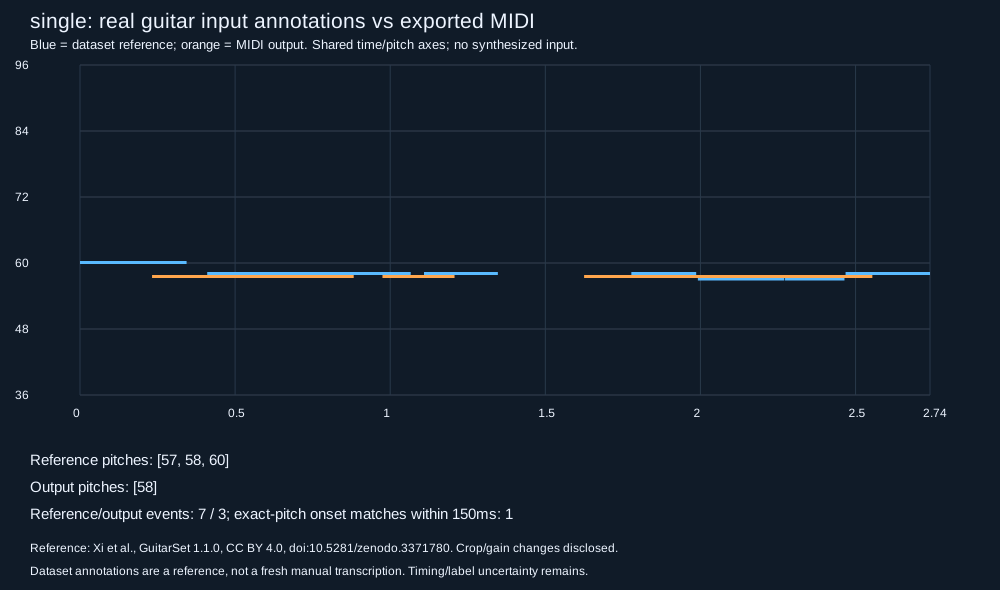
Control 1: a real single-note phrase
The reference phrase contains MIDI pitches 57, 58 and 60, while the exported MIDI contains only pitch 58. Evidence.
Seven annotated events became three exported events in this run. Evidence.
Only one event met our comparison rule of equal integer pitch and an onset difference no larger than 150 milliseconds. Evidence.
Two exported events remained unmatched under that rule, and six reference events had no matching output event. Evidence.
The longest exported note lasts approximately 0.929 seconds, spanning multiple short reference events in the later part of this crop. Evidence.
Input WAV · Output MIDI · Input/output pitches and times
Control 2: a real chord performance
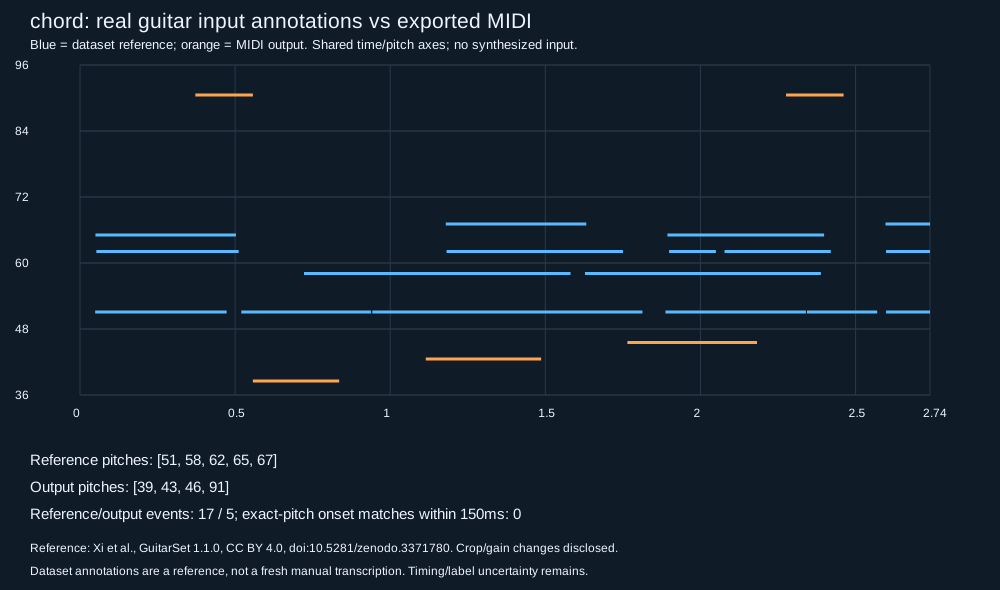
The comping crop contains annotated pitches 51, 58, 62, 65 and 67, but the output pitches are 39, 43, 46 and 91. Evidence.
The input and output pitch sets have no integer pitches in common for this excerpt. Evidence.
Seventeen annotated events became five exported events, with zero exact-pitch onset matches under the same 150-millisecond rule. Evidence.
The output has maximum overlap one even where the reference contains four simultaneous notes. Evidence.
Treat the low-register candidates, missing simultaneous notes and unsupported high events as separate editing decisions. Evidence.
Input WAV · Output MIDI · Input/output pitches and times
Control 3: the same recorded phrase at half amplitude
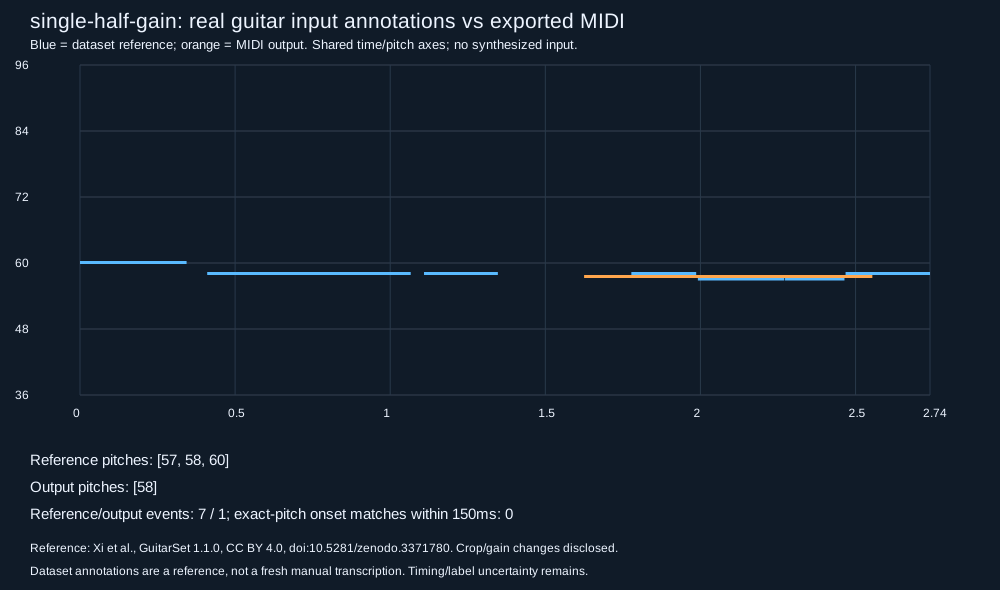
We multiplied the single-note crop samples by one half and rounded them back to signed 16-bit integers, without changing its timing or synthesizing replacement audio. Evidence.
That controlled amplitude change reduced the output from three events to one, although both runs exported only pitch 58. Evidence.
The remaining event starts at approximately 1.625 seconds in both outputs. Evidence.
The unchanged output pitch set therefore conceals a changed event count in this control. Evidence.
This test does not establish the best input gain for another guitar or prove that amplifying a recording will repair its transcription. Evidence.
Half-amplitude recorded input · Output MIDI · Pitch/time ledger
Check the handoff, then reproduce the comparison
Retain the source audio and compare both individual pitches and simultaneous notes before accepting this kind of draft. Evidence.
Our checker assigns each reference event to at most one eligible output event, using exact semitone pitch and the nearest onset within the declared tolerance, without an offset-duration acceptance criterion. Evidence.
An independent Python reader decoded the actual exported MIDI files and verified their pitches and timing against the detector output within three milliseconds. Evidence.
A fresh-directory repetition produced byte-identical WAV crops and exported MIDI files, with the hashes retained in the reproduction report. Evidence.
Download the reproduction instructions, crop.py, convert.mjs, the unchanged detector snapshot, the independent MIDI reader, reference notes and detector output.
What this measurement does not establish
These are two short excerpts from one player and one dataset session, plus an amplitude control, not a guitar-wide accuracy benchmark. Evidence.
The dataset annotations are partly automated and may contain errors, so the comparison is against a disclosed reference rather than unquestionable ground truth. Evidence.
We did not test live playing latency, a hardware pickup, Jamstik, Fishman, or competing converters, and our results cannot rank those products. Evidence.
The published detector functions were run in a local JavaScript harness, not through an asserted DAW session, and the piano rolls plot parsed data rather than listening judgments. Evidence.
A 150-millisecond onset criterion is an explicitly chosen comparison rule, not a claim about acceptable musical timing or a universal evaluation standard. Evidence.
Choose the next check
The conversion guide provides the broader workflow, while this page preserves the recorded inputs and failed outputs for this specific case. Evidence.
Use the note-duration comparison for a separate controlled timing example, and the DAW routing guide when the problem is getting events into a receiving track. Evidence.
Original recordings and annotations: Q. Xi, R. Bittner, J. Pauwels, X. Ye and J. P. Bello, GuitarSet 1.1.0, DOI, CC BY 4.0; crops, amplitude control, measurements and plots are modifications made here, without implying endorsement.
Sentence/claim evidence ledger · Sentence-based original-evidence audit · Download hashes