Audio to sheet music:
can sound recover the spelling?
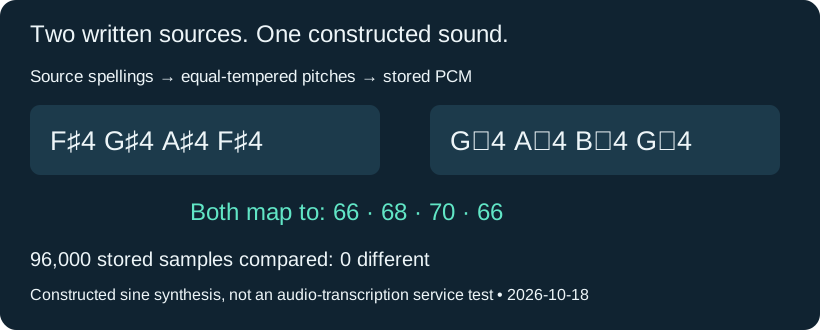
To turn audio into sheet music, transcribe its pitches and timing, then review the notation with musical context. Matching the sound does not prove you recovered the original written note names. In the controlled equal-tempered example below, two differently spelled sources generate byte-identical audio. The recording cannot tell those two source spellings apart.
AudioToMidiNow makes an editable MIDI draft from a clear single melody. It does not generate sheet music, PDF or MusicXML from your upload. The example files below are constructed by our own script, not outputs from an automatic transcription service.
Two source spellings. Identical exported samples.
On October 18, 2026, we wrote two short MusicXML sources. Each contains four quarter-note positions at 120 BPM. One uses F♯4–G♯4–A♯4–F♯4 with a six-sharp key signature; the other uses G♭4–A♭4–B♭4–G♭4 with a six-flat signature. These files intentionally preserve different written choices.
Sharp-spelled source
F♯4 · G♯4 · A♯4 · F♯4
MusicXML: F/G/A/F with alter +1.
Source XML: 1,011 bytes.
Flat-spelled source
G♭4 · A♭4 · B♭4 · G♭4
MusicXML: G/A/B/G with alter −1.
Source XML: 1,015 bytes.
Our script reopens those sources, reads their step, alteration and octave fields, and maps both to the same numerical pitches: 66, 68, 70, 66. It then synthesizes both with the same equal-tempered sine oscillator, phase, envelope, level and timing. This controls the sound generation rather than comparing two musicians whose tuning or articulation might differ.
| Check | Sharp-spelled source | Flat-spelled source | Pair result |
|---|---|---|---|
| Written pitch fields | F+1, G+1, A+1, F+1 | G−1, A−1, B−1, G−1 | Different |
| Numerical pitches | 66, 68, 70, 66 | 66, 68, 70, 66 | Equal |
| Saved WAV size | 192,044 bytes | 192,044 bytes | All bytes equal |
| PCM frames compared | 96,000 | 96,000 | 0 different samples |
| Minimal MIDI size | 69 bytes | 69 bytes | All bytes equal |
Download the 13-column score-review worksheet. Measured examples, recommendations and a blank observation are labelled separately. We repeated the generation in fresh directories and matched all six file hashes and every recorded result.
What this pair establishes
In this construction, the mapping from written pitch fields to sound is many-to-one: two different source representations produce exactly the same input for a hypothetical audio transcriber. An audio-only operation presented with those identical samples cannot use that sound to distinguish which of these two files we originally chose. It can propose a spelling; that proposal is not proof of the source's identity.
This is not the claim that notation is arbitrary or that context is useless. A key, chord progression, melodic function, instrument part or an existing score can guide an appropriate spelling. Nor does it say every real F♯ and G♭ performance has identical tuning. The equality here follows from our chosen twelve-tone equal-tempered mapping and matched synthesis conditions.
Our minimal MIDI intentionally contains pitch events, tempo and timing without a key-signature or source-label message. Its equality demonstrates only this export design. MIDI files can carry additional metadata; we are not claiming that every MIDI file lacks all key or notation context.
Review a transcription in two passes
- First check the sounding events. Compare pitches, octaves, starts, releases and missing or extra events with the same passage of the recording. A PDF that looks tidy is not that comparison.
- Then check written choices. Examine the key signature, enharmonic spellings, meter, readable rhythm and part assignment. A note that sounds correct may still be awkwardly named in its harmonic context.
- Keep source recovery separate from a useful arrangement. Decide whether you need a playable chart or the original author's exact notation. If exact source identity matters, seek the original score or other provenance; an equally sounding alternative does not certify it.
- Preserve an editable handoff. Retain your original recording, the reviewed note draft and the editable score. Keep enough context to explain any respelling rather than silently treating a software default as recovered fact.
- Record unknowns honestly. If the original score is unavailable, mark original spelling as unverified. That does not make a carefully reviewed working score unusable.
The worksheet leaves space for a source passage, sounding-note check, written choice, supporting context and next action. Our two measured rows describe this synthetic pair, not your recording or a commercial service's output.
Where audio transcription ends and score editing begins
If you start with MP3, WAV, humming or another recording, choose a transcription path suited to that source. With this site, use a clear single melody, inspect the MIDI draft, then open it in a notation editor. For that later import-and-cleanup stage, follow the existing MIDI-to-sheet-music guide. It covers actual note-import examples; this page addresses what the upstream sound cannot uniquely identify.
The same boundary applies when you search for sound to sheet music, MP3 to sheet music or audio to notes. An audio container does not supply a unique original spelling, and renaming an audio extension does not create a score. A full ensemble also poses source-separation and overlapping-note questions that this four-event construction does not test.
Keep those questions separate: our audio-to-MIDI workflow guide explains source preparation and inspection, while the stem content check explains why complementary outputs alone do not prove a source was isolated. Neither is a guarantee of an exact recovered score.
Download and reproduce the comparison
Sharp-spelled construction
Flat-spelled construction
Full measurements and six SHA-256 fingerprints · Standalone Node script · Review worksheet
Both complete WAV files have SHA-256:
a712cb93617001d99ce7cff53863865ad62853c9b2fca1bb8e3684e7058797ff
Each WAV is two seconds of 48,000 Hz, mono, signed16 PCM: 96,000 frames and a 44-byte header. A quarter position spans 24,000 samples. Each constructed tone lasts 21,600 samples followed by 2,400 samples of silence, with matched 480-sample attack/release ramps. This is a chosen synthesis articulation, not a claim that MusicXML quarter notes require this acoustic gate.
Pitch mapping: n = 12 × (octave + 1) + natural-step offset + alter, where C/D/E/F/G/A/B offsets are 0/2/4/5/7/9/11. Frequency is 440 × 2^((n−69)/12) Hz. The script uses the same oscillator phase and amplitude calculation after either source is parsed, then reads back every signed16 sample and compares the files.
The W3C MusicXML pitch reference defines the step/alter/octave representation; its alter reference defines semitone changes. Those format definitions support our encoding. The downloadable paired files and checks are our own constructed demonstration, not a reproduction of a transcription model.
node reproduce.mjs --out ./repeat
node reproduce.mjs --out ./repeat --check
Use a fresh directory. The script retains previous observations and creates a new repeat folder when checking. Original private metadata calls this preparation because the files were made before the search gate cleared; it does not describe a model run or a service response.
Not tested: automatic pitch detection, a commercial audio-to-score service, real piano or voice, notation-app import or rendering, listening quality, alternate tunings, full mixes or original-score recovery from real music. XML pitch fields were parsed by our own bounded reader, not a general MusicXML validator. The six-file check is not a transcription-accuracy percentage.