Acapella extractor:
Do two stems prove a clean vocal?
No. An acapella extractor aims to separate a vocal audio track from a mixed recording; getting two files, even ones that rebuild the mix exactly, does not prove the voice was isolated. Choose the vocal output, reopen it and check its content separately from the instrumental. This site does not provide an acapella-extraction upload service; the example below is an export check, not a separation tool.
Keep two acceptance checks separate
01 / CONTENT
Is the intended part in this file?
Solo the saved vocal, then the instrumental, against the same source passage. Check missing words, backing vocals, instrumental bleed and changed attacks or tails. A filename is not evidence of its contents.
02 / RECONSTRUCTION
What happens when the parts add up?
With matching alignment, channels and gains, compare the combined stems with the source. A small residual describes their sum. It cannot tell you whether the intended content went into the right stem.
These are recommended checks for your own permitted recording, not listening or audio-editor tests performed here. Keep the original untouched. Compare corresponding sections at sensible listening levels; do not let a louder preview decide which export is better.
For an actual extraction, select the output you need: an acapella is the vocal side; an instrumental extractor aims for the accompaniment. A two-stem split and a multi-part stem-separation workflow need not offer the same categories. Inspect the service's current outputs rather than assuming that “vocals” means lead voice only, or that every file in an audio-stems folder is a clean isolated source.
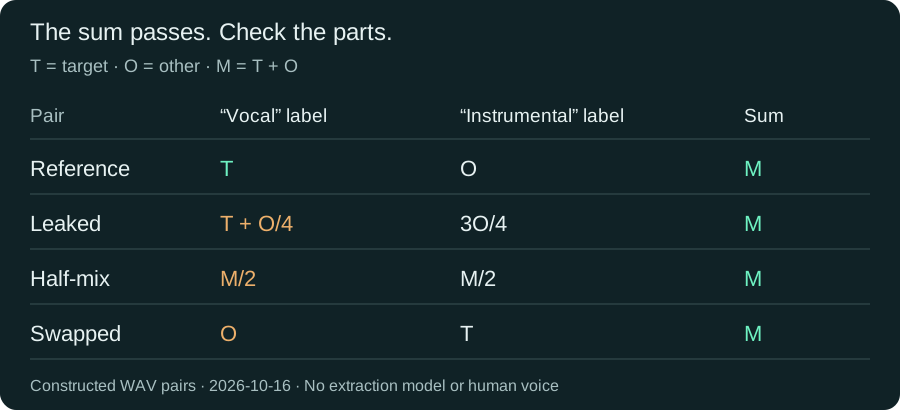
Four pairs. Every sum is exact. Three target files are wrong.
Collected and independently repeated October 16, 2026, on the test machine. We generated two known mathematical components: a 440 Hz target and a 660 Hz other tone, then saved their sum and four deliberately constructed pairs as actual WAVs. Neither tone is a human voice or instrument. No acapella extractor or separation model ran. The labels below are intentionally assigned test labels.
| Constructed pair | 440 Hz in “vocal” label | 660 Hz in “vocal” label | Known-target RMS error | Sum residual max / RMS |
|---|---|---|---|---|
| Reference T / O | 8,000.121 | ≈ 0 | 0 | 0 / 0 |
| Leaked T + O/4 / 3O/4 | 8,000.121 | 1,000.009 | 707.113 | 0 / 0 |
| Half-mix M/2 / M/2 | 4,000.061 | 2,000.019 | 3,162.322 | 0 / 0 |
| Swapped O / T | ≈ 0 | 4,000.037 | 6,324.644 | 0 / 0 |
Scroll sideways for every column; with a keyboard, focus the table and use the arrow keys. All amplitudes and errors are integer-sample counts, not dB, percentages or vocal-quality ratings. “≈ 0” hides only floating-point fitting residue; exact values are in the JSON.
The recombination check uses all 288,000 stored frames: labelled vocal + labelled instrumental − original mix. Both its maximum absolute error and RMS are exactly zero in every row. The component amplitudes instead use seconds 1–5. The known-target RMS error compares the entire labelled-vocal file with our known 440 Hz reference, which an unknown real recording normally does not provide.
- Leaked: the target label keeps a quarter of the other component. Its partner contains the remaining three quarters. Their errors complement each other, so the sum still passes.
- Half-mix: both files are the same half-level mixture. There is no isolated target in either, yet adding them restores the source exactly.
- Swapped: the target exists, but it is in the file labelled instrumental. Summation ignores the labels, so it cannot detect that mistake.
This is a counterexample, not a prevalence estimate: perfect reconstruction is insufficient to establish correct separation. It does not imply that a nonzero residual always means an unusable acapella. Different export gains, alignment, lossy encoding or processing also require investigation. Do not reject or approve an unknown song using our synthetic numbers as universal thresholds.
A small vocal-export acceptance card
- Record the source and intended part. Keep the original, its filename/hash and the exact passage. Decide whether you need lead vocals, all vocals, or the instrumental. Do not change that goal halfway through a comparison.
- Open both downloaded files independently. Check that the saved files, not only web previews, contain the intended parts. Start with a section where the target is obvious, then a difficult overlap or quiet ending. Mark content observations explicitly as listening observations.
- Check the export context. Note sample rate, channels, duration, alignment and any gain change. A valid WAV header establishes format, not vocal isolation. A matching hash establishes file identity, not sound quality.
- Use reconstruction only for its own question. If you compare the sum, retain the exact selections and gains and record the residual separately from content. Missing context is “not checked,” not zero.
- Approve for the next job. A stem usable for a remix may still contain distracting material for note detection. Check that next job separately; do not treat two downloads or a successful MIDI export as a certificate of clean vocals.
The 13-column export-check worksheet includes the four measured constructions, clearly marked recommendations and a blank row. Leave unavailable reference errors blank. It is not a separator, a blind voice-quality meter or a recording-upload form.
Download the exact constructed exports
- Known sources: 440 Hz target · 660 Hz other · original mix
- Reference: labelled vocal · labelled instrumental
- Leaked: labelled vocal · labelled instrumental
- Half-mix: labelled vocal · labelled instrumental
- Swapped: labelled vocal · labelled instrumental
- Full measurements and WAV/PCM SHA-256 hashes · standalone Node reproduction script · acceptance worksheet
Each of the eleven files is 576,044 bytes: 288,000 mono frames, 48,000 Hz, signed 16-bit integer PCM, six seconds. Eleven filenames do not mean eleven different waveforms: the swapped/reference and two half-mix labels deliberately share content. The complete-file and PCM hashes make those equalities checkable.
Check the known-target fingerprint
Complete WAV SHA-256:
6625f1a1c30aa9bfb262765f639565e5feb797b4cb929e30f100dad0fd13c7cbUse the JSON to check every file, including deliberately identical pairs. A fingerprint is not an accuracy score.
Method, reproduction and boundaries
For sample index n, the target is 4 × round(2000 × sin(2π × 440 × n / 48000)); the other component is 4 × round(1000 × sin(2π × 660 × n / 48000)). Their sum forms the mix. Multiples of four permit the quarter and half constructions to remain exact integers when written to 16-bit WAV. We reopen each saved file, check the header, read every stored sample, then measure the sum residual and reference difference. The Microsoft WAVEFORMATEX reference documents channel, rate, sample-format and frame-alignment fields.
Known-frequency amplitude uses sine and cosine sums over seconds 1–5: 2 × hypot(sine sum, cosine sum) / sample count. Both frequencies complete integer cycles in that selection. RMS error is the square root of the mean squared sample difference. The amplitude fit depends on our known tones; it does not recover an unknown clean human vocal from a mix.
The general sum constraint is established research: a 2018 paper on differentiable consistency constraints describes mixture consistency as the estimated sources summing to the input. Our contribution is the dated, downloadable counterexample and acceptance record, not the invention of that principle or a replication of the paper's speech-enhancement results.
node reproduce.mjs --out ./repeat
node reproduce.mjs --out ./repeat --check
Use Node in a fresh folder; no audio application, model or FFmpeg is needed. The script refuses to replace an observation record and retains a fresh repeat directory. All eleven WAV hashes and all four measurement rows matched our independent repeat. No production converter code was modified.
Not tested: human voice, recorded music, extraction-model performance, commercial services, uploads, listening quality, DAW import, browser audio decoding or MIDI accuracy. These constructed files cannot establish a best extractor, real-song isolation score, complete recovery or universal acceptance threshold. Use recordings you own or have permission to process and reuse; extraction itself is not permission to publish someone else's audio.
This is not the opposite-channel cancellation diagnosis: that page tests averaging left/right channels before a detector. Nor is it background-noise treatment, which compares gain, gaps and filtering. For the later transcription and note-cleanup stages, keep the existing MP3-to-MIDI workflow guide beside the checked stem.