Drums to MIDI:
check hits before mapping the kit
For drums to MIDI, check hit timing and the receiving kit’s note map separately; a pitched-note file is not automatically a ready-to-play drum pattern. findings.json · channel-control.json
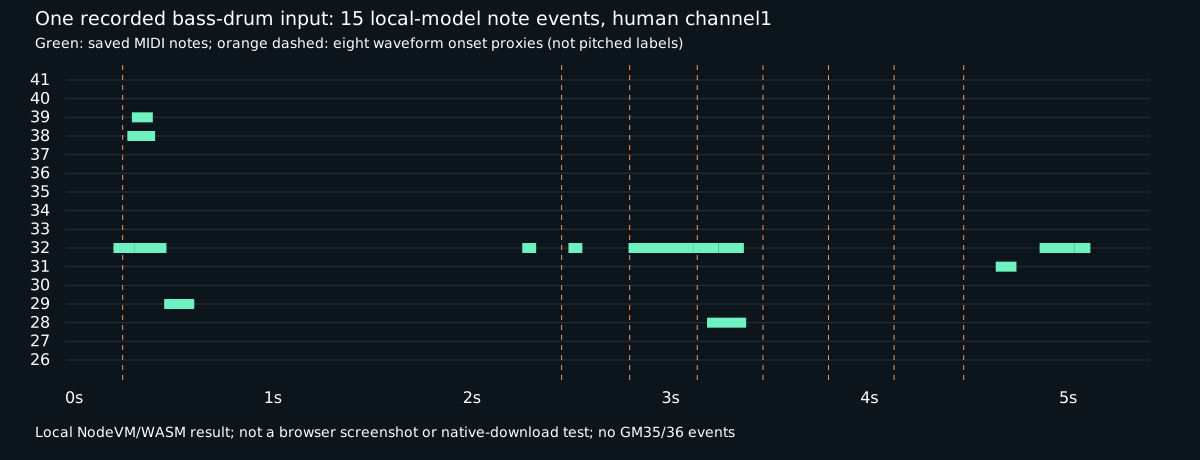
Our one real bass-drum recording produced fifteen local-model MIDI events against eight waveform onset proxies, with four timing matches under the stated rule and no General MIDI bass-drum keys. findings.json
2. One recording and one model execution
The input is the untouched Bass drum.ogg credited to Clngre, created March31,2005 and offered under CC BY-SA3.0; it is a recorded acoustic source, not a synthesized drum or a newly recorded performance. source-provenance.json · ATTRIBUTION.md
We ran the unchanged public worker once in NodeVM with WASM, Balanced mode2 and a local-file fetch adapter, then wrote its actual returned notes using the exact production MIDI writer. local-runtime-protocol.json · local-model-result.json · current-pipeline-excerpt.js
This was a local script experiment, not a successful browser conversion or download; browser automation could not select the file, and current Google ordering remained unavailable behind a CAPTCHA. execution-scope.json
3. Check hit timing before counting success
A simple200ms quiet-gap rule initially grouped the recording into two regions rather than the eight visible attacks, so we retained that failed segmentation proxy and froze separate waveform reference windows before observing model output. reference.json · source-inspection.json · source-envelope.svg
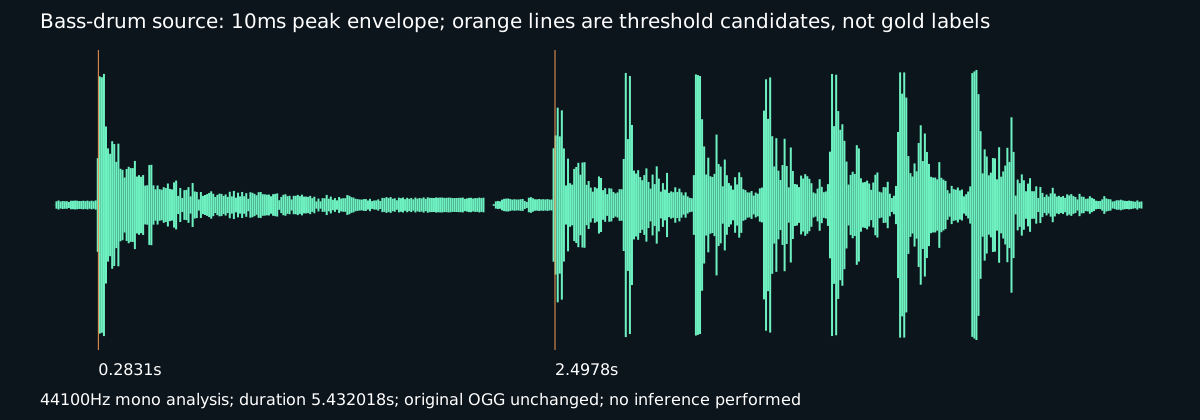
The independent saved-file checker matched the nearest unused output onset within50ms on the same decoded-PCM timeline, ignoring pitch for this timing-only check and fitting no shift. analyze-local-result.py · findings.json
Four reference proxies remained unmatched and eleven output events had no accepted proxy match, so the fifteen-event count does not describe fifteen recovered strikes. findings.json
The four matched onset differences ranged from−20.625ms to+34.491ms; these are differences against waveform-derived proxies rather than a general transcription-accuracy percentage. onset-pairs.csv · findings.json
The first reference review window,0.20–0.45seconds, contained four exported note starts even though it covers one separated waveform attack. reference.json · findings.json · output-notes.csv
The last four reference proxies were unmatched, while three exported onsets occurred more than50ms after the last proxy, making the later part of the draft a separate cleanup target. findings.json · output-notes.csv
| Independent check | This saved local result |
|---|---|
| Waveform reference proxies | 8 |
| Output note events | 15 |
| Timing-proxy matches within50ms | 4 |
| Unmatched references / outputs | 4 / 11 |
| Human channel / simultaneous notes | 1 / maximum3 |
| GM35/36 keys, original / channel-only edit | 0 / 0 |
4. Check the receiving drum map
The saved output used note numbers28,29,31,32,38 and39, with no35 or36 bass-drum key under the declared General MIDI receiver map. findings.json · output-notes.csv
All fifteen events were on human MIDI channel1, and the parsed draft reached three simultaneous notes despite the source being one bass-drum recording. findings.json
General MIDI percussion uses channel10 and maps35 and36 to bass-drum sounds, while a custom drum rack may choose different receiving channels and keys. reference.json · General%20MIDI%20Standard%20Percussion%20Set%20Key%20Map.pdf
The source label identifies a drum family rather than a target musical pitch, so we do not score these low note numbers as incorrect pitched notes or claim a multi-class drum-recognition rate. reference.json · findings.json
5. Channel-only negative control
Our explicitly editorial channel-only control changed thirty MIDI status bytes from channel1 to channel10, preserving every parsed note’s pitch, onset, duration and velocity. channel-control.json · editorial-channel10-only.mid · channel-only-control.py
The edited file still contained zero35 or36 keys, demonstrating that changing only the channel does not supply the missing bass-drum assignments in this result. channel-control.json · editorial-channel10-only.mid
That edited file is a negative control, not a second model run or a browser export; the untouched actual local-model MIDI remains available beside it. channel-control.json · actual-local-kick.mid
6. Inspect and reproduce the saved files
The original local-model MIDI is161bytes, format0 with one track,480ticks per quarter note and a500000microsecond tempo, with no dangling notes found by the independent parser. findings.json · actual-local-kick.mid · midi_reader.py
Recalculate the saved-file findings and channel-only comparison with the supplied Python scripts; neither analysis command decodes a new recording or runs transcription. analyze-local-result.py · channel-only-control.py · README.md
For a receiving drum kit, inspect the wanted attack positions, remove unwanted events and verify the kit’s assignments before changing every event to one drum key. findings.json · channel-control.json
python analyze-local-result.py
python channel-only-control.py
7. Limits and source scope
The analysis decoder returned5.432018seconds while the source page reports5.411995seconds, a roughly20.023ms difference that prevents treating this local timeline as a verified native-browser timeline. source-inspection.json · reference.json
The reference windows were visually reviewed but are not performer or hardware annotations, and this one bass-drum example does not test snare, hats, full mixes, external converters or other browsers. reference.json · execution-scope.json
Ableton’s documented drum conversion separately attempts kick, snare and hihat identification, while Vocuno and DrumsMIDI describe drum-specific workflows that we did not benchmark. research-review.json · · drums-to-midi-converter ·
The reviewed fixed rivals and drum-specialist pages already explain transcription or kit mapping; our contribution is this bounded, downloadable timing and MIDI-routing check, not a claim of missing competitor features or a verified Google ranking. research-review.json · execution-scope.json
8. Choose the next workflow
Use the related note-transcription study for pitched instruments and the General MIDI channel guide for message routing; neither changes the one-recording scope of this drum test. findings.json · research-review.json